I remember a Wednesday morning in June, about eight years ago. A student in our Kolkata classroom, let’s call her Shreya, had been sitting with The Hindu since 6:30 AM.. When I went to check on her, she was still struggling at page no. 4; she was visibly scared and told me that she didn’t want to leave anything. What if the exam asks something I skipped?” That single question told me everything that was wrong with how UPSC aspirants approach the newspaper. And it set off a quiet, stubborn effort at Kavish IAS to redesign the morning reading ritual from the ground up.
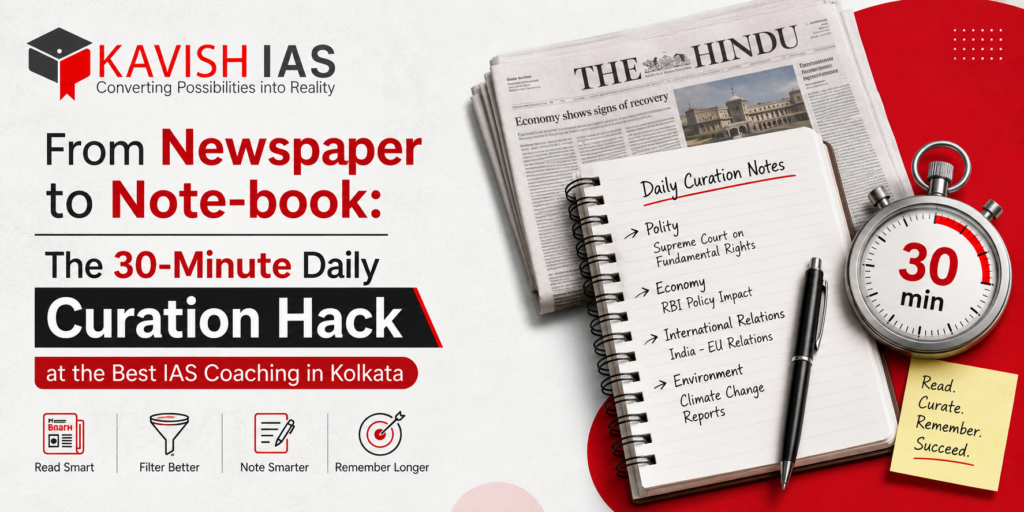
Today, when students call us the best IAS coaching in Kolkata for current affairs integration, they are often reacting not to a marketing promise, but to the outcome of that effort: a 30-minute curation method that has pulled hundreds of aspirants out of the overwhelm Shreya felt. This article is my attempt to walk you through that method — not as a set of instructions, but as a live habit that you can feel yourself building.
Why Three Hours on a Newspaper Fails Despite All the Effort
Most UPSC advice starts with “skip sports and city news.” It is not wrong, but it treats the symptom. The root problem is something I have seen in almost every beginner I have mentored: the absence of a mental map of the syllabus. When you haven’t internalised what the UPSC actually examines, everything in the newspaper seems urgent. A student once told me, “I highlighted so much that my paper turned yellow.” She was joking, but her notes were unusable.
The hidden cost of those marathon reading sessions is not just wasted time — though that is real. If you spend three hours a day on the newspaper for a year, you lose over 800 hours that could go into answer writing, optional revision, or simply resting. The more serious damage is that your brain gets used to consuming without filtering. You remember fragments. You mix up events. You walk into the exam hall with a head full of headlines and very little that you can retrieve cleanly under pressure.
At Kavish IAS, we began attacking this problem by asking a different question: not “what should they read?” but “what mental habit do they need to build?” The 30-minute curation ritual is the answer we arrived at.
The Core Shift: Becoming a Curator, Not a Consumer
The shift sounds small, but it changes everything. A reader’s job is to understand what the writer is saying. A curator’s job is to select only what belongs in a larger purpose. For a UPSC aspirant, that purpose is clear: the official syllabus document that UPSC publishes on its website. That document — not the newspaper — is the real brief.
When I walk into the classroom at 7:00 AM with a physical newspaper, I do not tell students to “read carefully.” I tell them: “We have 30 minutes. Let’s pick what belongs in our syllabus map and leave the rest. Nothing else matters.” The first few days are messy. They panic at skipping an editorial. By the end of the month, most of them are curating faster than I can.
The 30-Minute Ritual We Run Every Morning
I want to describe the ritual exactly as we practise it, with a timer, in a room full of aspirants. It is silent, unglamorous, and deeply practical. I usually sit with my own newspaper and do it alongside them, thinking aloud until their filters sharpen.
Minute 0–5: Hunting for Syllabus Keywords
We don’t read a single paragraph yet. I have the students run their eyes over every headline on the front page, the national page, the editorial page, and the business page with one question: “Do I see a direct UPSC syllabus word?” By that I mean a term the syllabus actually uses — like “parliamentary committee,” “inflation targeting,” “biodiversity hotspot,” “Article 21.” If a headline doesn’t trigger that recognition, we skip the article instantly. No hesitation.
After a week of daily practice, I notice something beautiful: the room gets quiet because students are discarding headlines in seconds. That is the first taste of syllabus instinct. They realise that 65–70% of a typical newspaper has zero connection to the exam. The anxiety about missing something starts to loosen its grip.
Minute 5–8: The Three-Lens Check
Now we have maybe six articles left. Before we read them, I ask them to hold each article up to three lenses:
– Could this spawn a factual Prelims question? (a year, a name, a legal article, a threshold)
– Could this become a Mains issue — a governance failure, a policy conflict, a social pattern?
– Is there an interview angle — a human dimension or a tricky ethical knot?
If an article clears none of these, I ask them to drop it. On a typical day, only three or four articles pass. These are the ones we read actively, with a pencil. No more.
Minute 8–22: The One-Page Note That Changes Everything
I’m going to be blunt here: the way most aspirants take notes is broken. They write small essays that they never revisit. In our classroom, we have a strict rule: for each article, only three lines.
The Core:What happened, in one sentence.
The Static Link: Which exact syllabus topic does this connect to? (For example, not just “polity” but “Article 22, preventive detention.”)
The Exam Trigger: One Prelims keyword or one Mains question stem.
Here is an actual note from our board, based on a Supreme Court observation about preventive detention:
Core: SC said detention orders must show a live and proximate link to the threat; they cannot be used as a shortcut for criminal law.
Static Link: Article 22, GS2.
Prelims trigger: Maximum detention without advisory board approval — 3 months.
*Mains trigger:* “Examine the tension between preventive detention laws and individual liberty in India.”
That took under three minutes to write, and it fits in two lines. When the student revisits this note six months later, it reactivates the whole concept. We never allow full-sentence summaries because we’ve seen repeatedly that longer notes collect dust. The magic is in the compression.
Minute 22–25: Rehearse Without Peeking
After the notes are written, I tell everyone to close the newspaper and read only their “Core” and “Static Link” lines for three minutes. This is a tiny retrieval practice, and it makes a real difference. I’ve tracked this informally with students who skip this step — they recall far less a week later.
Minute 25–28: File It Where It Belongs
At Kavish IAS, every student keeps a physical binder divided by GS paper and sub-topics. The day’s single sheet of notes goes into the appropriate divider. By the time December rolls around, they have a self-made current affairs compendium organized exactly as the syllabus is organized. No bulky yearly compilation to buy. No last-minute scramble.
Minute 28–30: A Quick Honest Check
We end by comparing our curated set with a daily reference digest we share internally. The point is not self-criticism; it’s calibration. If a student consistently misses, say, environmental news, we know their filter needs adjustment. I’ve seen students go from 50% accuracy to near-perfect alignment in two months.
Why This Works When Generic Advice Fails
Most “how to read newspapers for UPSC” content online tells you the same thing: skip sports, read editorials. That advice is widespread but shallow. It doesn’t address the emotional core — the fear of missing something that made Shreya cry. Our method works because it builds a filtering muscle through daily, guided repetition. It respects the fact that the brain learns to discard only when it knows exactly what to keep.
After about 40–50 sessions, the students stop needing the timer. The three-lens check becomes automatic. I’ve had former students tell me they can now spot an exam-worthy article from three feet away. That is not a talent; it is a trained instinct.
A Real Outcome (Without Overpromising)
One of our foundation-course students — let’s call him Arnab — joined us after a failed attempt. In his first attempt, he had spent 2.5 hours on the newspaper and found himself too exhausted to write answers. Within eight weeks of our morning ritual, he had compressed his reading time to 25 minutes. The saved hours went straight into daily answer writing under exam conditions. In his next Mains, his score improved by nearly 50 marks. I am not claiming the curation method alone caused that jump — sound preparation involves many factors. But Arnab himself told me that the reclaimed time and mental clarity were central to the turnaround.
Stories like his are the reason students keep calling us the best IAS coaching in Kolkata for current affairs preparation. The phrase comes from their experience of a system that reduces anxiety and delivers usable, revisable knowledge.
Mistakes That Creep Back In
Even after learning the method, some students slip. Here are the three I catch most often:
-Curating too many articles. If your daily set goes beyond five, you are probably including marginal material. Pull back to three or four very strong ones.
Writing summaries instead of cues. A note that runs more than three lines is not curation — it is reproduction. The point is retrieval, not archiving.
Skipping the filing step. Notes left in a rough notebook rot. The two-minute filing ritual is small, but it compounds. I insist on it.
A Small Word on Resources
We rely entirely on the UPSC syllabus as our primary filter. I keep a printed copy of that syllabus on the classroom wall and point to it during sessions. For those who want a broader perspective on newspaper reading, a piece like this one by The Indian Express can be a decent supplement. But I always caution students: no external guide replaces the daily act of filtering with your own hands.
Frequently Asked Questions
Can a beginner really finish in 30 minutes?
In the first week, it might take 40–45 minutes. That’s fine. By the third week, the timer starts winning. We’ve seen hundreds of beginners settle into the groove if they stay consistent and allow themselves to be imperfect at first.
What if I miss a major article that everyone discusses?
Missed articles happen. They sting, but one missed article never decides an exam. The real exam-killer is the habit of reading everything and retaining nothing. A well-designed daily digest catches most gaps over a week.
Is this method rigid?
It is deliberately structured at the start because the mind needs a scaffold. After a few months, the structure dissolves and you’re left with an instinct. That’s the goal.
Do I still need to read editorials?
Only the ones that engage with a policy, governance, or rights issue. An editorial that is purely a political opinion piece — skip it without guilt. I tell students: if it won’t help you write a balanced Mains answer, it is not your job today.
If You Want to Build This Habit With Us
The newspaper will arrive tomorrow morning, as it always does. If you are tired of drowning in it, consider walking into one of our morning sessions at Kavish IAS, best IAS coaching in Kolkata, we don’t lecture about current affairs; we curate alongside you until the filtering becomes second nature. The 30-minute ritual I’ve described here is not a product we sell; it’s the way we start every single day.
If you’re in Kolkata, I invite you to visit us, see a live session, and decide if this rhythm feels right for you. The only thing you stand to lose is the 2-hour fog that has probably been weighing you down.
Written by: Academic Team, Kavish IAS
Our Academic Team has spent two decades sitting across the table from UPSC aspirants—listening, guiding, and turning research-backed methods into simple, actionable revision habits.