On the Eve of India’s 80th Independence Day
“India can transform its growing economic strength into global economic leadership through investment in human capital, manufacturing, infrastructure, technology and innovation”-Barack Obama
Introduction
Every Independence Day, India does more than celebrate freedom. It also asks itself a fundamental question: What kind of country do we want to become?
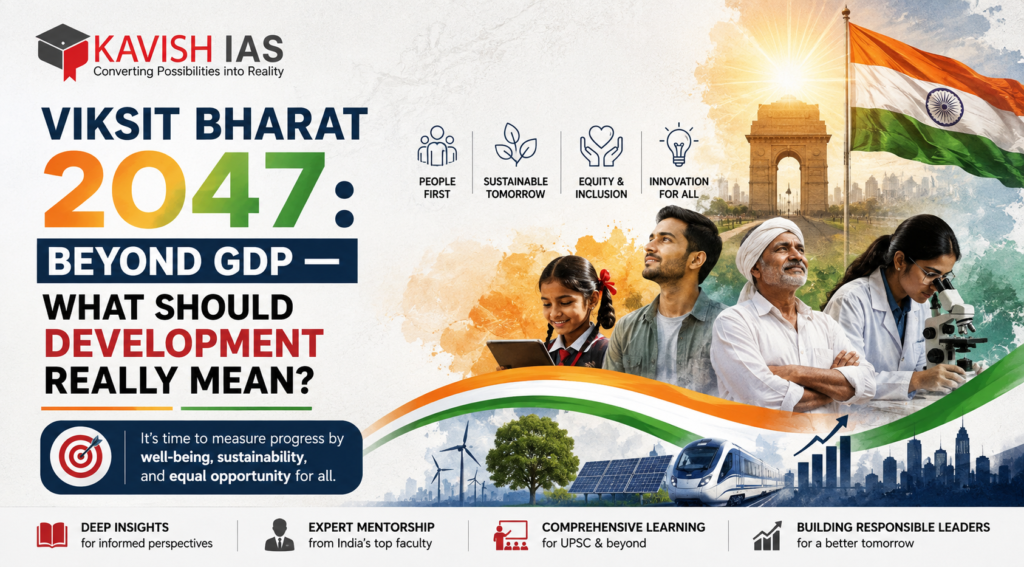
As India stands on the eve of its 80th Independence Day in 2026, the answer is increasingly being framed around one ambitious national vision — Viksit Bharat @2047, when India will complete 100 years of Independence.
But there is a deeper question that deserves attention: What exactly does a “developed India” mean?
Is it simply a larger GDP, higher per-capita income and more skyscrapers? Or should development also mean better health, quality education, productive employment, gender equality, environmental sustainability, social security and a better quality of life?
For UPSC aspirants, this distinction is crucial because development is not merely an economic concept; it is a multidimensional process of expanding human capabilities and opportunities.
From GDP Growth to Human Development
GDP remains an important indicator of economic performance. A growing economy creates resources for infrastructure, welfare, innovation and employment.
However, GDP alone cannot tell us whether the benefits of growth are reaching ordinary citizens.
Therefore:
Economic Growth ≠ Development
A more meaningful understanding is:
Development = Economic Growth + Human Development + Inclusion + Sustainability + Quality of Life
India’s Development Journey: Significant Progress, Significant Challenges
India has made substantial progress in several development indicators.
According to the UNDP’s Human Development Report 2025, India’s HDI value increased from 0.676 in 2022 to 0.685 in 2023, and India ranked 130th among 193 countries.
Similarly, the NITI Aayog SDG India Index 2023–24 recorded India’s composite score rising from 66 in 2020–21 to 71 in 2023–24.
Yet, the journey is far from complete. The World Bank continues to classify India as a lower-middle-income economy in its FY2027 classification.
Therefore, the challenge before India is not merely to grow faster, but to convert economic growth into broad-based human prosperity.
The Five Dimensions of a Truly Developed India
1. A Prosperous India
A developed India must have a strong, productive and competitive economy.
This requires:
• Higher productivity
• Modern manufacturing
• Strong MSMEs
• Innovation and R&D
• Better infrastructure
• Global competitiveness
• Quality employment
Economic growth provides the financial foundation on which other dimensions of development can be built. But growth must also generate productive jobs, particularly for India’s young population.
2. A Healthy and Educated India
A country cannot become truly developed if its citizens lack access to quality healthcare and education.
Human capital is the real wealth of a nation.
Better education → Better skills → Higher productivity → Better incomes → Better quality of life
India’s development journey therefore requires greater emphasis on foundational literacy and numeracy, skill development, research and innovation, affordable healthcare, nutrition, preventive healthcare, and digital and technological literacy.
The objective should not simply be more educational institutions, but better learning outcomes and employable skills.
3. An Inclusive India
Growth becomes meaningful only when its benefits reach different sections of society.
A developed India must ensure opportunities for women, youth, farmers, workers, MSMEs, marginalised communities and the rural population.
The transition from welfare to empowerment is particularly important.
The question is not merely “How much assistance does the state provide?” but “How effectively can citizens become economically independent?”
4. A Sustainable India
India cannot achieve development by destroying the ecological foundations on which development itself depends.
Climate change, water stress, air pollution, biodiversity loss, extreme heat and land degradation can undermine economic progress.
Therefore, Viksit Bharat must also mean:
Green Growth + Resource Efficiency + Clean Energy + Climate Resilience
NITI Aayog reports that India’s SDG Goal 13 score increased from 54 in 2020–21 to 67 in 2023–24.
The real challenge, however, is to create a model where economic growth and environmental protection reinforce each other rather than compete with each other.
5. A Better Quality of Life
Perhaps the most important dimension of development is also the one most difficult to capture statistically.
Imagine an India where roads are efficient, public transport is reliable, cities have clean air, citizens have access to green spaces, government services are easy to access, healthcare is affordable, women feel safe, young people find meaningful employment, and citizens have confidence in public institutions.
That is development in its most tangible form.
A developed country should not merely be a country where people earn more. It should be a country where people live better.
The Viksit Bharat Framework
VIKSIT BHARAT 2047
Prosperity + Human Capital + Inclusion + Sustainability
↓
Better Quality of Life
↓
HUMAN-CENTRIC DEVELOPMENT
The central idea is simple:
GDP should be a means to development, not the definition of development.
From Swatantra Bharat to Viksit Bharat
India’s Independence journey can be understood through different phases:
1947 → Political Freedom
↓
Economic Planning & Institution Building
↓
1991 → Economic Liberalisation
↓
Digital & Infrastructure Transformation
↓
2047 → Viksit Bharat
The meaning of freedom itself has also evolved.
Political freedom liberated India from colonial rule.
Economic development aims to liberate citizens from poverty, unemployment, deprivation and lack of opportunity.
Thus, the next stage of India’s development journey should be about expanding the real choices available to every citizen.
What Should India Aim for by 2047?
VIKSIT BHARAT 2047
Economic Prosperity + Social Well-being + Ecological Sustainability
↓
Better Quality of Life
This approach also makes Viksit Bharat relevant to the Sustainable Development Goals (SDGs) rather than treating development as a purely economic race.
The Road Ahead
India’s journey towards 2047 will require a combination of high economic growth and deep structural transformation.
The country needs to move:
• from low productivity to high productivity,
• from informal employment to productive employment,
• from quantity-based education to learning and skills,
• from curative healthcare to preventive healthcare,
• from resource-intensive growth to sustainable growth,
• and from government-centric development to citizen-centric development.
Technology will be an important accelerator, but technology alone cannot create development. Institutions, human capital, social trust and effective governance are equally important.
The ultimate test of Viksit Bharat will therefore not simply be whether India becomes one of the world’s largest economies.
The deeper test will be:
Can India’s economic rise translate into dignity, opportunity, security and a better quality of life for its citizens?
Conclusion
As India stands on the eve of its 80th Independence Day, the vision of Viksit Bharat @2047 offers an opportunity to rethink the meaning of development.
A developed India should certainly be economically powerful. But it should also be healthy, educated, inclusive, innovative, environmentally sustainable and institutionally strong.
The true measure of development is not merely how much wealth a nation produces, but how that wealth expands the capabilities and choices of its people.
India’s journey from Swatantra Bharat to Viksit Bharat is therefore not simply a journey towards a bigger economy.
It is a journey towards a better society.
And perhaps that is the most meaningful way to understand the dream of Viksit Bharat 2047:
“Not merely a richer India, but a better India — where economic strength becomes a means to human dignity, opportunity and national well-being.”
UPSC Mains Value Addition
GS-II: Governance, welfare, inclusion, human development
GS-III: Economy, employment, infrastructure, sustainable development
Essay: Development vs Growth; Inclusive Growth; Viksit Bharat @2047
Geography Optional: Human development, regional disparities, sustainable development
Possible Mains Question:
“Economic growth is necessary but not sufficient for development. Discuss in the context of India’s vision of Viksit Bharat @2047.”