
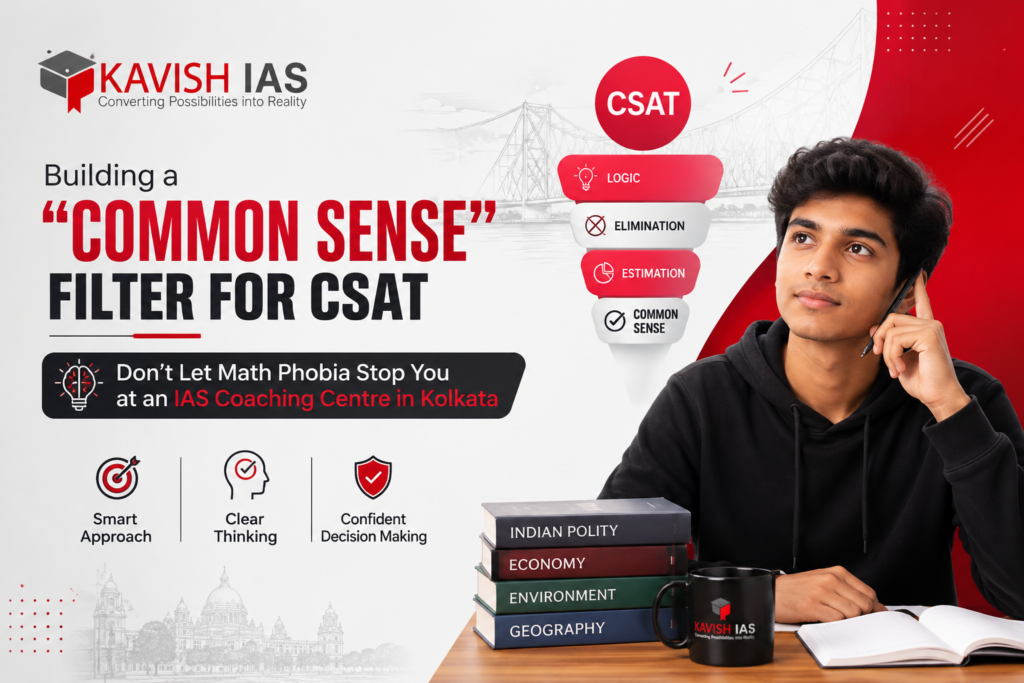
Ritika walked into our classroom sometime in June. Peak Kolkata humidity, the kind that makes your shirt stick to your back. She sat in the third row, notebook open, but she didn’t write a word. Just stared at the desk. After the session, she waited until the room emptied out, then came up and said, almost in a whisper — “Sir, I haven’t done any maths since Class 10. CSAT is going to finish my UPSC dream, isn’t it?”
I’ve heard that line, or something very close to it, hundreds of times now. Any serious ias coaching centre in kolkata has a Ritika in every batch. The fear is real. And, honestly, the fear is usually the bigger enemy than the actual math.
I’m not going to give you a magic formula. There isn’t one. What I can share is how we’ve been helping students chip away at this fear, slowly, one tiny win at a time. No heavy jargon, no phonebook-sized books of shortcuts. Just something we started calling the Common Sense Filter.
The Real Problem Isn’t the Sums. It’s the Freeze.
Let’s get one thing clear. CSAT is a qualifying paper. You need 66 marks out of 200. That’s 33%. The UPSC doesn’t expect you to be a walking calculator. They just need to know you won’t freeze when a number pops up in a file someday.
But here’s what actually happens. Somewhere in school — class 7, maybe 8, 9 — a lot of us had a bad moment. Called to the blackboard, got a step wrong, someone giggled. Or we sat through a whole exam with our chest tight. That memory doesn’t leave. It parks itself somewhere at the back of the mind, and when the CSAT booklet opens and a percentage or a bar graph shows up, the brain hits panic mode. Not thinking. Just surviving.
After CSAT 2024, the Indian Express wrote about how candidates found the reasoning and maths questions unexpectedly stressful. That stress then bled into the comprehension section, the logical reasoning — stuff they actually knew how to handle. One rough patch with numbers, and the whole paper started wobbling.
This is exactly where the Common Sense Filter helps. It’s less about solving and more about not panicking.
So, What Exactly Is This Filter?
It’s not a technique you’ll find in a textbook. It’s more of a mental habit, a way of looking at a CSAT problem like you’d look at a restaurant bill you’re splitting with friends. You don’t pull out a calculator and work things to the paisa. You roughly estimate, cross out the nonsense options, and go with what feels sensible.
Here’s a real example from class.
Question: The price of something goes up by 25%, then a 10% discount is offered on that new price. What’s the net change from the original?
Now, a student with math anxiety sees this and their brain immediately starts fishing for a formula. They think, “25 minus 10 is 15, but that’s probably wrong,” and then they just… freeze. The formula isn’t coming. Clock’s ticking.
The Filter way is simpler. Make up a nice round number. Say the original price was Rs.100. Up 25% — that’s Rs.125. Then 10% off 125 — that’s Rs.12.5 less, so Rs.112.5. Net increase from Rs.100 is Rs.12.5. That’s 12.5%. Done. No formula required. Just a made-up number and a couple of tiny steps.
At our ias coaching centre in kolkata, we actually start with this kind of thinking before we even touch the syllabus. “Forget school,” we tell them. “Imagine you’re bargaining at New Market. Is the final price more or less than where you started?” If you know that, you’re halfway there. The numbers are just how you write it down.
Why Those Fat Arithmetic Books Often Backfire
I’ve seen it happen way too many times. An aspirant, scared stiff of CSAT, goes to College Street and buys a thick book of quantitative aptitude. Pipes and cisterns, probability, time and work — pages and pages of sums. They grind for months. And then in the actual exam, they still freeze.
The thing is, UPSC isn’t testing how fast you can compute. Go look at old papers. In most quant questions, the answer choices are spread far apart. Like 10%, 25%, 60%, 85%. If your rough estimate says “it’s around a quarter,” you’ve got your answer without the exact calculation. Trying to be precise when the options are that far apart just eats time and feeds doubt.
Traditional coaching — the kind that treats CSAT like a banking exam — teaches you to chase that precision. For someone who’s already scared of numbers, that’s like telling a person with a fear of heights to walk faster on a tightrope. It just makes the anxiety worse.
We do things a bit differently. We tell our students: “You’re not a calculator. You’re training to be an officer who can make decent calls with incomplete data. So act like it.” That small shift — how they see themselves — it sounds simple, but I’ve seen it work.
How We Build the Filter, Day by Day
This bit takes time. Not months, but a few weeks of slightly uncomfortable daily practice. The discomfort is actually the point. When you have a pen and you’re writing steps, the brain goes on autopilot. But that autopilot is fragile. Forget one step, and the whole thing falls apart. So we take the pen away.
Every day, for about fifteen minutes, we put ten questions on the screen. No notebooks open. Just a blank sheet of paper, and they’re told: don’t write anything. The first week is painful. People fidget, sigh, a few try to secretly scribble on their palm. But somewhere in the second week, something clicks. Someone blurts out — “Eliminate A and D, definitely… it’s between B and C, and C feels too high.” They’re approximating, trusting their gut. The common sense is finally waking up.
Then we have this little thing called a fear tracker. After every mock test, each student writes down which type of question made their stomach tighten. Next to it, in their own words, they jot one simple trick for next time. After a month, that sheet is better than any formula book. I remember a history postgrad who was terrified of percentages. In her tracker she wrote: “If it asks for a growth rate, just compare the rise to half the original. That’s usually enough.” She scored 88 in CSAT.
These aren’t polished success stories. They’re just what happens when you give a frightened mind permission to be practical instead of perfect.
A Small Story That Stayed With Me
A few years ago we had a student, Shoaib. Sharp guy, could debate governance policies for hours. But say “compound interest” and his face shut down completely. He’d failed CSAT once before. By one mark. One.
He joined us and for the first ten days barely spoke during the CSAT sessions. I’d see him staring at the screen during no-pen drills, jaw tight, like he was expecting a blow.
Then one day we put up a simple pyramid puzzle — find the missing number. And Shoaib just called out the answer. Quick, calm. I asked how he did it. He shrugged and said, “The pattern looked obvious. The differences were a kind of zigzag.”
That was it. He wasn’t seeing numbers as threats anymore. He was seeing shapes, patterns, little stories. He cleared CSAT the next year. He’s in the Indian Postal Service now. He still writes sometimes. Once he told me, “Sir, I still use that filter at work. When my department sends a messy spreadsheet, I mentally round everything off, get the big picture, and only then ask for exact figures.”
That, right there, is the whole idea. The Common Sense Filter isn’t just for an exam. It’s something you carry into real life. And UPSC, whether they mean to or not, rewards exactly that.
Starting on Your Own (Before You Join Any Coaching Centre)
You don’t need to wait. You can start nudging your brain in a different direction right now. Here’s what I’ve seen actually work.
Read the newspaper with a slightly different eye. When you see vote share percentages or budget figures, round them off in your head. Don’t calculate. Just feel it. “Is this roughly half? A third? Negligible?” Sounds too simple, but after ten days your number sense gets noticeably sharper.
Play the elimination game with CSAT practice questions. Don’t solve it first. Just look at the four options. Cross out the ones that are obviously impossible. If a population growth question has options like -20% or 150% and the data shows a steady rise, you’ve already thrown out two. That little mental win builds a surprising amount of confidence.
Practice with slightly uncomfortable timers. Give yourself 20 minutes for a mixed set — maths, reasoning, comprehension — and force yourself to make quick calls. You’ll get some wrong. That’s fine. The point is to break the overthinking habit.
Keep a small CSAT diary. Not formulas. Just your own little discoveries. “Today I figured out that 15% of 88 is roughly 13 — I just took 10% (8.8) and half of that (4.4) and added.” These small wins pile up faster than you think.
And if you can, sit among other humans who are fighting the same fear. Math phobia loves isolation. In a room full of people who are also struggling, the fear feels less personal. It becomes a shared thing, and that’s so much easier to beat.
Why the Right Classroom Atmosphere Matters
I’m not here to push you into joining a coaching centre. You can definitely make progress on your own. But if the fear is deep-rooted — the kind that’s been squatting in your head since childhood — there’s something about being in a physical room with others that helps.
At Kavish IAS, we keep batches small. Not as a marketing gimmick. It’s because the faculty needs to see your face when a tough question appears. The small frown, the way you put your pen down. That’s when a teacher can lean in and ask, “What’s going through your head right now?” That kind of attention gets lost in a crowd of 300.
And the peer thing is honestly underrated. When you watch someone next to you — someone just as scared — figure out a DI set using nothing but common sense, it shifts something in your own mind. You stop feeling like “the one who’s bad at maths” and start feeling like a problem-solver. That identity shift? Half the battle, if not more.
Frequently Asked Questions
I’ve avoided maths for years. Is clearing CSAT actually possible?
Yes. You only need 33% to qualify. Many students with serious math anxiety clear it by leaning on comprehension, reasoning, and smart approximation instead of heavy calculations.
How long before this Common Sense Filter thing starts working?
Small wins usually show up in two to three weeks of daily no-pen practice and elimination exercises. Real confidence takes about a month, give or take, depending on how regularly you work at it.
Do I need an IAS coaching centre in Kolkata for this, or can I manage alone?
You can absolutely start on your own with the methods above. But if the fear is old and stubborn, being around peers and an experienced mentor often speeds up the mental shift quite a bit.
What if I still can’t solve some maths questions during the actual CSAT?
Totally fine. You’re not aiming for full marks. The idea is to grab the easy stuff, use common sense for the rest, and never let a tough number mess up your performance in reasoning or reading. You can skip a few and still pass comfortably.
How do I find out if Kavish IAS is right for me?
We offer a free demo session where you can sit in on a no-pen drill and get a feel of the classroom. You can also talk to current students. Details and address are on https://kavishias.in/
A Last Thought Before You Let the Fear Win
This ended up being a long read, I know. But if you’re someone who has lost sleep over CSAT, I want you to hold onto one thing: this paper isn’t testing your maths. It’s testing whether you can keep your head and use the plain sense you already have. The 33% bar is low for a reason.
You don’t need to become a genius. You need to become someone who can glance at a number without panicking. That’s doable. I’ve watched it happen with people who had genuinely given up hope.
If you’re around Kolkata, come sit in on one of our no-pen drill sessions at ias coaching centre in kolkata. The first ten minutes you’ll probably hate it. But then something might click. And that tiny click — that quiet “oh, that’s it?” — could be where your math phobia finally starts to crack.
Written by: Academic Team, Kavish IAS
Our Academic Team has spent two decades sitting across the table from UPSC aspirants—listening, guiding, and turning research-backed methods into simple, actionable revision habits.
This piece draws from more than ten years of classroom experience at Kavish IAS. For official CSAT guidelines, always check the [UPSC Civil Services Examination notification](https://upsc.gov.in/sites/default/files/Notif-CSP-24-engl-140224.pd f). The news reference mentioned is from [The Indian Express’s CSAT 2024 analysis](https://indianexpress.com/article/education/upsc-csat-2024-students-complain-maths-reasoning-questions-9344775/ ).*