
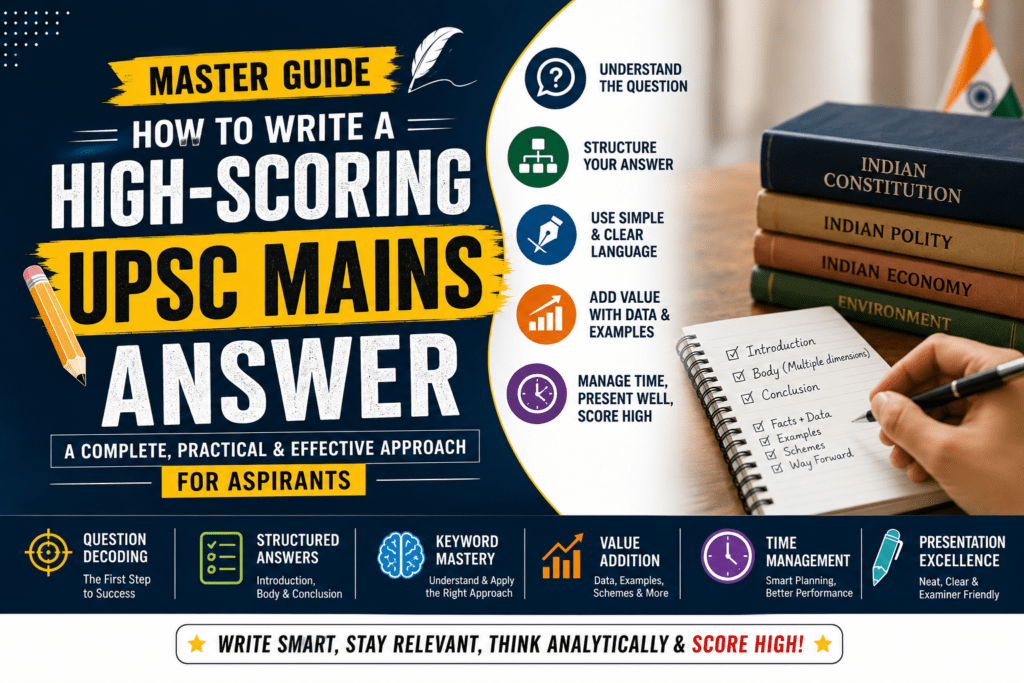
(A Complete, Descriptive & Practical Approach for Aspirants)
Writing a good UPSC Mains answer is not simply about knowing facts or writing long paragraphs. It is about presenting your knowledge in a clear, structured, and examiner-friendly manner within a limited time. Many aspirants struggle not because they lack content, but because they fail to understand what the question demands and how the answer should be framed.
This guide explains everything in a simple and practical way — from understanding the question to mastering UPSC keywords and writing a perfect answer.
🎯 STEP 1: Understanding the Question is Half the Answer
Before you begin writing, the most important thing is to carefully understand what the question is actually asking. UPSC questions are designed in a way that tests not only your knowledge but also your ability to interpret instructions.
You must identify:
- What is the core theme of the question?
- What is the directive word (keyword) like discuss, examine, or elucidate?
- Which dimensions are expected — social, economic, political, or ethical?
💡 A common mistake aspirants make is rushing into writing without decoding the question properly.
👉 Golden Rule:
If you misunderstand the question, even the best content will not fetch marks.
🏗️ STEP 2: A Well-Structured Answer Always Wins 💯
A UPSC answer is not random writing — it follows a logical flow that makes it easy for the examiner to read and evaluate.
Every good answer generally follows three parts:
🟢 Introduction (The Opening Frame)
The introduction should set the context of your answer. It should not be long or complicated. Instead, it should give a clear entry point into the topic.
You can begin with:
- A simple definition 📖
- A recent fact or report 📊
- A relevant example 📰
👉 The purpose is to quickly show that you understand the topic and are ready to address it.
🔵 Main Body (The Core of the Answer)
This is the most important part of your answer and where most of the marks are awarded. The main body should reflect depth, clarity, and structure.
Instead of writing in long paragraphs, break your answer into meaningful ideas. You should try to cover multiple dimensions of the issue such as causes, impacts, challenges, or solutions depending on the question.
Using small headings, bullet points, or logical flow makes your answer easier to read and understand.
💡 Adding data, examples, government schemes, or reports like NITI Aayog or UN studies can significantly improve the quality of your answer.
👉 The key here is not just writing more, but writing relevant and structured content.
🔴 Conclusion (The Closing Thought)
A good conclusion gives your answer completeness. It should not introduce new ideas but instead summarize the issue in a balanced way.
A strong conclusion often:
- Summarizes the core argument 🧾
- Maintains a balanced perspective ⚖️
- Provides a way forward or solution 🚀
👉 A thoughtful conclusion reflects maturity in your answer.
✍️ STEP 3: Simplicity in Language is a Superpower
One of the biggest misconceptions among aspirants is that using complex vocabulary improves marks. In reality, UPSC values clarity over complexity.
Your focus should be on:
- Writing short and clear sentences ✂️
- Avoiding unnecessary technical jargon 🚫
- Explaining ideas in a simple way 🧠
👉 Remember, the examiner should understand your answer in one reading without confusion.
📊 STEP 4: Value Addition Makes Your Answer Stand Out 🔥
In a sea of thousands of copies, what makes your answer different is value addition. This means adding extra elements that enhance the quality of your answer.
This can include:
- Relevant data from reports 📊
- Diagrams or flowcharts 🗺️
- Real-life examples 🌍
- Government schemes or policies 🏛️
👉 Even small value additions show that you have a broader understanding of the topic and not just textbook knowledge.
⚖️ STEP 5: DO’s and DON’Ts Every Aspirant Must Know
In UPSC answer writing, small mistakes can cost marks, while small improvements can increase scores significantly.
✔ DO’s (What you should always do)
You should always ensure that your answer remains focused on the question. Structure your answer properly using introduction, body, and conclusion. Writing in points instead of long paragraphs improves readability. Regular practice and revision also play a crucial role in improving answer quality over time.
❌ DON’Ts (Common mistakes to avoid)
Avoid writing irrelevant content just to increase word count. Do not ignore keywords in the question as they define the structure of your answer. Overly long paragraphs, excessive use of difficult words, and memorized answers without understanding should also be avoided. Most importantly, never spend too much time on a single question.
🔍 STEP 6: Understanding UPSC Keywords (THE REAL GAME CHANGER) 💡
UPSC questions often contain directive words that guide how you should frame your answer. Understanding these keywords correctly can significantly improve your score.
✨ “Elucidate” – Explain Clearly
When a question says elucidate, your task is to explain the concept in a very clear and simple manner. You should break down complex ideas and make them easy to understand. There is no need for criticism or debate here — just clarity is the focus.
👉 Think of it as: “Make the concept crystal clear.” 💎
💬 “Discuss” – Present All Sides
A discuss question requires you to present multiple perspectives on the issue. You should include both positive and negative aspects in a balanced way. The tone should remain neutral and analytical.
👉 Think of it as: “Look at the issue from all angles.”
🔍 “Examine” – Deep Analysis
When asked to examine, you need to go beyond surface-level explanation. This means breaking the issue into parts and analyzing its causes, effects, and implications in detail.
👉 Think of it as: “Study the issue deeply and systematically.”
⚖️ “Critically Examine” – Analysis + Judgment
This is one of the most important keywords. Here, you are expected not only to analyze the issue but also to evaluate it. You should present both sides and finally give a balanced judgment.
👉 Think of it as: “Analyze deeply and then evaluate fairly.”
🗣️ “Comment” – Express Your View
In comment-type questions, you are expected to give your opinion on the issue in a concise manner, supported by logic or reasoning.
📊 “Analyze” – Break and Study Systematically
Here, your job is to break the topic into components and study each part logically. The focus is on structure and clarity of thinking.
📌 FINAL REVISION TABLE 🧾
Understanding these keywords properly ensures that your answer matches UPSC expectations.
| Keyword | What It Means | Focus |
| Elucidate | Explain clearly | Clarity |
| Discuss | Present all sides | Balance |
| Examine | Deep study | Depth |
| Critically Examine | Analyze + evaluate | Judgment |
| Comment | Give opinion | Viewpoint |
| Analyze | Break logically | Structure |
⏱️ STEP 7: Time Management in the Exam
Time management is extremely important in UPSC Mains. A well-written answer is useless if you cannot complete the paper.
- A 10-marker should ideally be completed in 7–8 minutes
- A 15-marker should take around 10–12 minutes
Regular timed practice helps improve both speed and accuracy.
🎨 STEP 8: Presentation Matters More Than You Think
Even a good answer can lose impact if it looks messy. A neat and well-structured answer creates a positive impression on the examiner.
Using headings, bullet points, spacing, and highlighting keywords (sparingly) improves readability and increases chances of scoring better marks.
🚀 FINAL THOUGHT
UPSC answer writing is not about writing more — it is about writing better, clearer, and more structured answers aligned with the question demand.
👉 If you master structure, keywords, and clarity, your marks will improve significantly without increasing your content burden.
🔥 KEY MESSAGE
✍️ “A great UPSC answer is not written in haste — it is thoughtfully structured, clearly expressed, and precisely aligned with the question.”