
Introduction
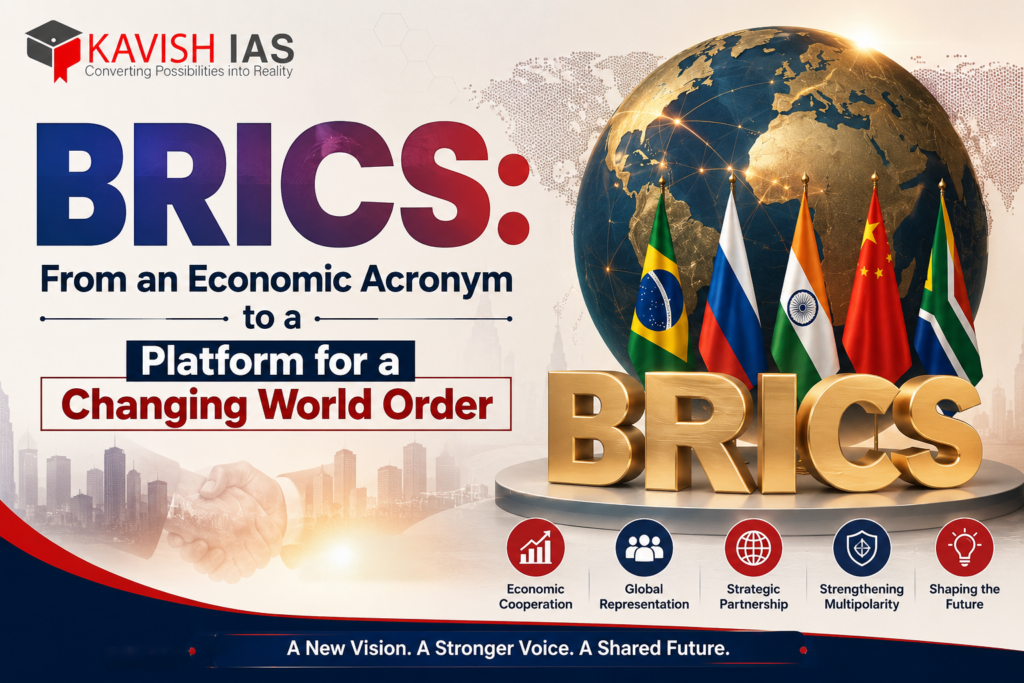
For years, BRICS was primarily seen as a grouping of emerging economies. Today, that description is no longer sufficient.
BRICS has gradually evolved into a broader platform through which emerging and developing countries discuss trade, finance, technology, climate change, development, global governance and the interests of the Global South.
Its growing importance can be understood from a simple fact: the original BRIC grouping consisted of only four countries—Brazil, Russia, India and China. Today, the grouping has expanded substantially, with India holding the BRICS Chairship in 2026 and preparing to host the 18th BRICS Summit in New Delhi on 12–13 September 2026.
But why was BRICS created in the first place? Why did it expand? And can it actually contribute to a more multipolar global order?
What Exactly Is BRICS?
BRICS is a grouping of major emerging-market and developing countries.
The original acronym BRIC represented:
B — Brazil
R — Russia
I — India
C — China
The term BRIC was originally coined by economist Jim O’Neill of Goldman Sachs in 2001 to describe major emerging economies whose economic weight was expected to increase significantly.
But BRIC was initially not a political organisation.
The countries gradually recognised that their economic weight could also provide a platform for greater coordination in international affairs.
The first BRIC foreign-ministers’ meeting took place in 2006, while the first BRIC leaders’ summit was held in Yekaterinburg, Russia, in 2009. South Africa subsequently joined, turning BRIC into BRICS.
Evolution
2001
BRIC coined as an economic concept
↓
2006
BRIC Foreign Ministers’ Meeting
↓
2009
First BRIC Leaders’ Summit
↓
2010–11
South Africa joins
↓
BRICS
↓
2024
Major expansion
↓
2025
Indonesia joins
↓
2026
India’s BRICS Chairship
Why Was BRICS Created?
The emergence of BRICS has to be understood against the background of the post-Cold War international economic order.
Institutions such as the IMF and World Bank were created in a different global economic environment.
Over time, emerging economies became increasingly important to global growth, trade and investment.
Yet their representation and voting power in major global financial institutions did not always reflect their growing economic weight.
This generated a broader demand:
If the global economy is changing, shouldn’t global governance change too?
Therefore, BRICS gradually became a platform for advocating:
• Greater representation of developing countries
• Reform of global financial institutions
• Greater voice for the Global South
• Increased South-South cooperation
• Greater economic and technological cooperation
• A more representative global governance system
BRICS Is Not NATO
This distinction is extremely important for UPSC.
BRICS is not a military alliance.
It does not have:
• a collective defence clause,
• a unified military command,
• a common foreign policy,
• or a supranational authority.
Instead, it is primarily a consultative and cooperative grouping.
Its cooperation broadly operates across three broad dimensions:
BRICS
│
├── Politics & Security
│
├── Economy & Finance
│
└── People-to-People Cooperation
Over time, cooperation has expanded into agriculture, education, health, science and technology, environment, labour, youth, communications and other areas.
Why Did BRICS Expand?
The expansion of BRICS is one of the most important developments in its history.
At the 2023 Johannesburg Summit, BRICS decided to expand its membership.
From January 2024, countries including Egypt, Ethiopia, Iran, Saudi Arabia and the UAE were brought into the expansion process, while Indonesia joined in 2025. Institutional sources currently describe the grouping as an 11-country platform.
This expansion has changed the geographical character of BRICS.
It is no longer simply:
Brazil + Russia + India + China + South Africa
It now has a much stronger representation of:
Asia + Africa + Middle East + Latin America
This strengthens BRICS’ claim to represent a broader Global South.
The Economic Significance
BRICS has considerable economic weight.
Its members collectively represent a very large share of the world’s population and global economic output. Indian government-linked material currently describes BRICS as representing over 40% of global population and around 37% of global GDP.
But economic size alone does not automatically create political influence.
The real question is:
Can BRICS convert economic weight into collective bargaining power?
That is where trade, finance, technology and global institutions become important.
New Development Bank: BRICS’ Financial Experiment
One of BRICS’ most important institutional achievements is the New Development Bank (NDB).
It was created to finance infrastructure and sustainable-development projects in member and other developing countries.
The broader idea was simple:
Developing Countries
↓
Infrastructure & Development Finance
↓
New Development Bank
↓
Alternative / Complementary Source of Finance
The NDB is significant because it demonstrates that BRICS cooperation can move beyond declarations into institution-building.
However, it does not replace the IMF or World Bank.
Rather, it provides an additional development-financing mechanism.
What About a BRICS Currency?
This is one of the most misunderstood aspects of BRICS.
There is frequent discussion about whether BRICS could create a common currency to challenge the US dollar.
But a common BRICS currency is not currently an established reality.
There are much more practical discussions around:
• increasing trade in local currencies,
• improving payment connectivity,
• reducing transaction costs,
• strengthening financial cooperation.
And this distinction is crucial.
Common Currency ≠ Local Currency Settlement
Common Currency
↓
Requires deep monetary integration
↓
Extremely difficult
Local Currency Trade
↓
Countries settle more bilateral trade
in their own currencies
↓
More feasible
Therefore, the immediate issue is not necessarily “Will BRICS launch a new currency?”
It is:
Can BRICS gradually reduce dependence on a single currency in some areas of international trade and finance?
The Geopolitical Dimension
BRICS has become increasingly important because the global order itself is becoming more fragmented.
The world today is witnessing:
• US–China strategic competition
• Russia–West tensions
• wars and instability in different regions
• supply-chain disruptions
• energy insecurity
• technological competition
• debates over sanctions and financial sovereignty
In this environment, countries are increasingly interested in strategic autonomy.
BRICS offers developing countries another diplomatic platform.
But this does not mean that every BRICS country wants to replace the existing international order.
Instead, many members seek to reform and rebalance it.
That distinction is particularly important for understanding India’s position.
India’s BRICS Strategy
India’s approach to BRICS is different from the idea that BRICS should become an anti-Western alliance.
India has simultaneously engaged with:
• BRICS
• G20
• Quad
• SCO
• Indo-Pacific mechanisms
• United Nations
• bilateral partnerships with the US, Europe, Japan, Russia and others.
This reflects India’s broader principle of:
Strategic Autonomy + Multi-Alignment
India wants stronger representation for developing countries while maintaining relationships across competing geopolitical blocs.
Therefore, India’s approach can be represented as:
BRICS
+
G20
+
Quad
+
SCO
+
UN
+
Bilateral Partnerships
↓
Strategic Autonomy
BRICS 2026: Why Is It Important Right Now?
This is where the topic becomes dynamic for UPSC.
India is chairing BRICS in 2026, under the theme:
“Building for Resilience, Innovation, Cooperation and Sustainability”
India has emphasised a people-centric and “humanity first” approach.
The 18th BRICS Summit is scheduled for 12–13 September 2026 in New Delhi.
But the important point is that India is not treating BRICS merely as an annual leaders’ meeting.
A series of ministerial and sectoral meetings have already taken place.
What Has India Focused On During Its 2026 Chairship?
Agriculture
The BRICS Agriculture Ministers’ Meeting in Indore focused on:
• food security,
• nutrition,
• livelihoods,
• agricultural trade,
• climate-resilient agriculture,
• regenerative farming,
• innovation and investment.
An Indore Declaration was adopted.
Trade
At the BRICS Trade Ministers’ Meeting in Jaipur, members worked on the BRICS Economic Partnership 2030, MSME financing and resilient global value chains.
Industry
The Industry Ministers’ Meeting focused on:
• MSMEs,
• photovoltaic industries,
• startups,
• logistics,
• industrial cooperation.
India also proposed a BRICS Incubator Network and a BRICS Startup Innovation Fund.
Labour
The Labour and Employment track focused on:
• social protection,
• women’s participation,
• skills,
• labour-market formalisation,
• digital technologies.
Digital Technology
The Communications Ministers’ Meeting in Pune focused on:
AI + next-generation networks + cybersecurity + digital infrastructure + digital skills + startups.
Environment
The Environment Ministers’ Meeting in August focused on climate change, biodiversity, pollution and disaster resilience, with India stressing implementation-oriented environmental cooperation.
So India’s BRICS presidency is attempting to move the grouping from geopolitical rhetoric to practical sectoral cooperation.
The Most Interesting Current Dynamic: BRICS and China
There is another reason the 2026 summit is particularly significant for India.
India and China are simultaneously competitors and BRICS partners.
Their relationship has been affected by the border crisis since 2020.
Yet diplomatic engagement has gradually resumed.
Now, China’s President Xi Jinping is expected to visit India for the September BRICS Summit, although Reuters reported on August 24 that the visit was not yet officially confirmed. Such a visit would be his first to India in seven years.
This creates an interesting paradox:
The same platform that brings India and China together multilaterally can also become a space for managing bilateral tensions.
That is why BRICS 2026 is important beyond economics.
But BRICS Has Serious Internal Contradictions
BRICS’ greatest strength—its diversity—is also its greatest weakness.
Consider the members:
India and China → strategic competitors
Iran and Gulf states → complicated regional dynamics
Russia and Western countries → deep geopolitical tensions
Democracies and different political systems → different approaches to governance
Therefore:
More Members
↓
More Economic Weight
↓
More Global Influence
↓
BUT
↓
More Divergent Interests
↓
Harder Consensus
This is one of the central challenges of BRICS expansion.
Carnegie’s analysis of India’s 2026 presidency identifies expansion versus institutional coherence as one of the key structural tensions facing the grouping.
So, Is BRICS Becoming an Anti-Western Bloc?
Not exactly.
This is an important UPSC analytical point.
BRICS certainly provides a platform for criticism of aspects of the existing Western-dominated global order.
But its members do not share a single ideology or a common strategic objective.
India, for example, continues to maintain deep economic, technological and strategic relations with the United States and Europe.
Therefore, it is more accurate to describe BRICS as:
A platform for greater Global South agency rather than a conventional anti-Western alliance.
The Future of BRICS
The future success of BRICS will depend on whether it can convert its enormous demographic and economic weight into institutional and practical cooperation.
Three questions will determine its future:
1. Can it deepen economic integration?
Trade among members needs to become larger, easier and more diversified.
2. Can it manage geopolitical differences?
India-China tensions alone demonstrate the difficulty.
3. Can it produce tangible institutions?
NDB, payment mechanisms, technology cooperation, research networks and trade frameworks will matter more than political declarations.
BRICS 2026: The Bigger Picture
The evolution can be understood like this:
BRIC
Economic Idea
↓
BRICS
Emerging-Economy Cooperation
↓
Expansion
Greater Global South Representation
↓
Financial & Development Institutions
↓
Trade + Technology + Climate + Agriculture
↓
Broader Global Governance Platform
↓
QUESTION:
Can it influence the emerging multipolar world order?
Conclusion
BRICS began as an economic concept describing four emerging economies.
Over two decades, it has evolved into a much broader platform for political consultation, economic cooperation and Global South coordination.
Its importance today comes not merely from the size of its members but from the changing nature of global power.
The world is moving towards greater geopolitical competition, multiple centres of economic power and increasing demands for reform of global institutions.
BRICS reflects this transition.
Yet, its future is not guaranteed.
Its members have enormous differences in political systems, economic interests and geopolitical priorities. Expansion can increase its global weight but also make consensus more difficult.
For India, therefore, BRICS is neither an alliance against the West nor simply an economic club.
It is an instrument of strategic autonomy, Global South diplomacy and institutional reform.
And India’s 2026 presidency provides a critical test:
Can BRICS transform its growing economic and demographic weight into practical cooperation and a stronger voice for developing countries in global governance?
That is the real question that the New Delhi BRICS Summit of September 2026 will begin to answer.
UPSC Mains Value Addition
GS-II: International Relations, Global South, multilateral institutions, global governance
GS-III: Trade, finance, technology, energy, agriculture, development
Essay: Multipolarity, reform of global institutions, strategic autonomy
Possible Mains Question:
“BRICS is evolving from an economic grouping of emerging economies into a broader platform for Global South cooperation. Examine its significance, internal contradictions and prospects in shaping a multipolar world order.”