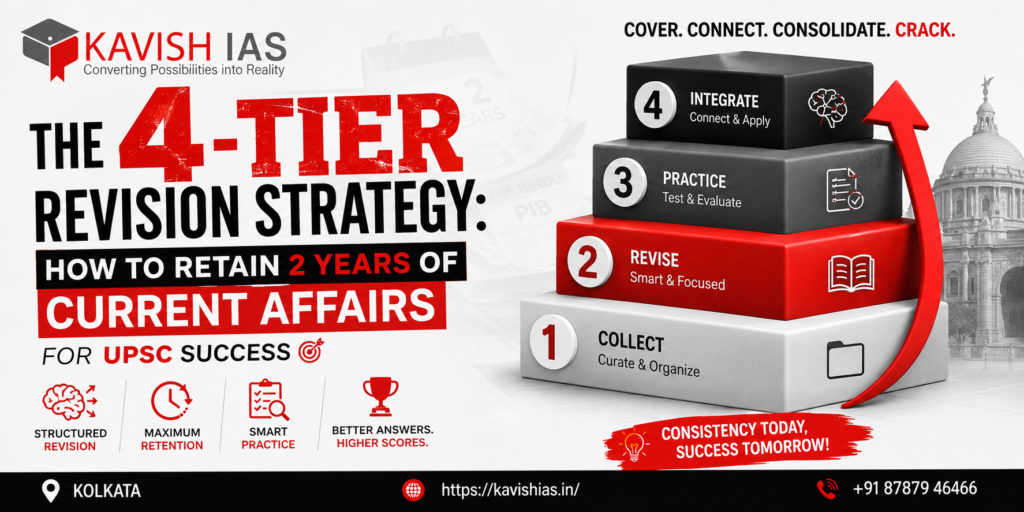
You know that sinking feeling, right? The one where you’ve been reading the newspaper every single day, highlighter in hand, pages marked, and yet when someone tosses a simple question at you about a recent summit your mind just… blanks. I’ve sat across the table from so many students in our Kolkata centre who told me exactly that. Not that they weren’t working hard. They were. But there was this quiet horror in their eyes, this fear that nothing was sticking. And that, really, is where the idea of our 4-Tier Revision Strategy first started taking shape. Not in some fancy planning meeting. It grew slowly, out of countless conversations with aspirants who were doing everything “right” and still feeling hollow. At our upsc coaching in kolkata, we began tracking what the students who actually cleared the exam were doing differently, and we noticed something. Over and over. It wasn’t about studying more. It was about revisiting the same piece of news in a way that felt almost natural.
A Little Science That Changed Everything
Here’s a little science bit that hit me hard when I first stumbled across it. Ebbinghaus, a 19th-century psychologist, showed that without some kind of reinforcement, we forget nearly half of new information within an hour. An hour. Not days. And a more recent paper in Psychological Science backed it up: if you pull the information out of your brain at well-spaced intervals, long-term retention can jump by as much as 200%. The study’s there for anyone who wants to dig deeper—[you can read it here](Visual Long-Term Memory Stores High-Fidelity Representations of Observed Actions – Zhisen Jiang Urgolites, Justin N. Wood, 2013 ). But honestly, the number that stuck with me was simpler: reading once and highlighting does almost nothing. The brain needs to be nudged into retrieving a fact when it’s just about to forget it. That one shift changed how we structured current affairs revision for our whole batch.
Now, I’ll be honest. When we first started talking about a four-step system, a lot of students raised an eyebrow. One of our early skeptics, a guy who was already swamped with work, told me, “Sir, I’m drowning in daily news, and you want me to add four more things?” Fair question.
But he soon realised that this system is doing the opposite, by removing work without piling. So let’s walk through the system , how it works with a class full of out of focus, tired students who want to go home and sleep.
Tier One: The Daily Prime Card
The first layer is something we call a Prime Card. At the end of a current affairs session whether it’s a newspaper discussion or a class on government schemes—we ask the student to take about ten minutes and scribble a tiny note. Not a summary. Not a rewrite. Just the bare bones: what happened, which part of the syllabus it links to, and one possible Mains question. When the Global Gender Gap Index came up in class a while back, the cards didn’t list every country’s rank. They had India’s position, the four parameters, a quick note connecting it to GS1 and GS2, and a question like “Examine India’s declining performance in global gender indices.” That’s it. Boiling it down to that handful of words is already a memory exercise, you’re making the brain do the heavy lifting. Over weeks, the cards become this personal, dog-eared diary of curated news. And I’ve seen the relief on faces when students realise they don’t need to reread the entire newspaper on weekends. I remember a working professional telling me her guilt just melted away because she could hold those cards and say, “I’ve done today’s work.” That’s a real shift.
Tier Two: Weekly Thematic Regrouping
But capturing something daily is one thing. By Friday, Tuesday’s news and Wednesday’s news start merging into a foggy mess. So the second tier is a weekly regrouping. We don’t go date-wise. Instead, we sit down and dump all the events of the week into buckets—economy, environment, polity, sci-tech, international relations. And then something kind of magical happens. Connections start forming on their own. A forest rights judgment sits next to a biodiversity bill, and a student suddenly blurts out, “Wait, these two are actually talking to each other.” That’s exactly the moment we’re after. I’ve watched people who used to hate current affairs begin to enjoy these sessions because the news stops being a list and starts feeling like a puzzle they’re solving. The mentors push these links deliberately, drawing messy diagrams on the board that nobody would ever publish. But they work. And when the brain weaves these associations, forgetting becomes genuinely harder.
Tier Three: Monthly Testing and Honest Feedback
The third tier is where we get brutally honest about gaps. At the end of each month, we run a test on the last 30 days of current affairs. It’s not a friendly little quiz. The multiple-choice questions are cooked up with the same twisted options UPSC loves, and the Mains questions demand analysis, not just recall. The test forces you to dig out information under pressure which is uncomfortable, no doubt, but incredibly effective. Afterwards, every student gets a report card that doesn’t sugarcoat. It says things like, “Your economic indices are weak. You’re mixing up different reports. Go back and revise chapters four and five.” So the student takes that report back to their Prime Cards and patches the specific holes, not the whole syllabus. We also make them explain topics to a peer in a review session. If you’ve ever tried to teach something you half-know, you’ll remember how quickly the gaps show up. That’s the whole point. By the time they’ve tested and discussed, that month’s news has been yanked out of memory at least once in an exam-like setting, which lightens the last-minute revision load like you wouldn’t believe.
Tier Four: Quarterly Full-Length Simulations
The final tier stretches the recall window to match the real exam cycle. Every quarter, we hold a full-length simulation that covers the entire previous one-to-two-year current affairs span. It’s not just a memory test. It’s a rehearsal for the physical and mental stamina you’ll need on exam day real OMR sheets, Mains answer booklets, the works. But here’s what makes it different from just rereading old notes: before each simulation, the faculty updates every major topic with the latest context. That Supreme Court order from last year? There’s now a new ruling that modifies it. The GDP figures from two quarters ago? They’ve been revised. So you’re not just revisiting the old fact; you’re layering on the newest perspective. This ability to discuss a topic with depth over time, the past and the present woven together is what fetches marks that static answers can’t. I remember a student who cleared Mains last year telling me that in her interview, when she traced a policy from its launch to its latest amendment, the board members leaned forward and nodded. That depth came from the quarterly simulations, not from any frantic end-of-year reading.
The Surprising Thing About Time
What often surprises people is that this whole process doesn’t eat up extra hours. It gives hours back. Most aspirants I meet are stuck in a loop, rereading monthly magazines from scratch, feeling productive while their recall stays fragile. The four-tier approach breaks that loop. You meet each topic in four different forms, once as a personal note, once as a thematic connection, once as a test response, and once as a fully updated narrative. By the time Prelims arrive, the revision is practically done, and the panic that grips so many others just… isn’t there. At our upsc coaching in kolkata, we’ve watched mock test current affairs accuracy cross 80% for those who stick to the rhythm. And their Mains answers stop being fact-dumps and start becoming arguments with examples stitched in.
I should mention that this system doesn’t float in the air as a nice theory. It lives inside our program in a very hands-on way. Students get booklets that are structured for the four tiers. The weekly thematic sessions run in small mentor-led groups, not huge impersonal classes. Monthly tests are compulsory and come with video solutions where we walk through every tricky option, slowly. The quarterly simulations are treated like proper academic milestones, and the review that follows is as thorough as a prelims strategy session. I stress this because I’ve seen aspirants try to copy the method alone, and consistency often cracks. The classroom setup provides the accountability and immediate feedback that make the real difference. Kind of like a gym partner—you’re far less likely to skip when someone is expecting you.
Frequently Asked Questions
How is this different from watching daily news analysis videos?
Videos are a solid start, I’ll give you that. But they’re mostly passive. You watch, you feel informed, and by the next day, most of it has evaporated. This strategy pushes you to create, connect, and test yourself, which shoves knowledge into long-term memory. It’s the difference between watching someone cook a dish and actually cooking it yourself. You only truly learn when your hands get messy.
I work full-time. Can I actually manage this?
A lot of our working students do. The daily Prime Card takes around ten minutes, maybe fifteen on a busy day. The weekly session can slot into a quiet Sunday evening. The monthly test is a couple of hours. The real time-saver is that you stop rereading entire booklets without direction—which, if you add it up, is where the hidden hours disappear in most people’s schedules.
Do you provide ready-made notes for all four tiers?
We give master compilations, schedules, and the full test series, but students write their own Prime Cards. Because writing is a memory tool you just can’t outsource. Those who rely completely on printed notes often find their recall shaky. The brain never had to do the condensing work, so the memories don’t hold.
What if I miss a weekly recap session?
The monthly test acts as a safety net. Your gaps show up in the diagnostic report, clear as day, and you can zero in on those areas before the next quarterly simulation. Missing one session doesn’t derail everything if you use the test feedback honestly.
—
A Final Thought
Current affairs can feel like a beast, something vast and unmanageable that grows bigger every day. But it doesn’t have to be that way. When you stop treating it like a pile to be crammed and start treating it like a conversation you keep alive through spaced revisits, something in your head shifts. The dread softens, and the facts begin to settle in a way you can actually trust. If the idea of a structured but flexible UPSC current affairs revision system speaks to you, maybe it’s worth seeing how we’ve woven it into the daily rhythm here. Many of our former students, now in the services, tell us it wasn’t the volume of news they consumed but the way they cycled through it that made the difference. Not a bad thing to hear.
[Take a look at our Current Affairs Course](https://kavishias.in/current-affairs-course )
[Check the Test Series details here](https://kavishias.in/test-series )
This method wasn’t cooked up in a boardroom. It came from late nights, tired students, honest feedback, and the quiet satisfaction of watching someone finally remember what they kept forgetting.
Written by: Academic Team, Kavish IAS
Our Academic Team has spent two decades sitting across the table from UPSC aspirants—listening, guiding, and turning research-backed methods into simple, actionable revision habits.
Reviewed by:Head of Curriculum, Kavish IAS
Published: